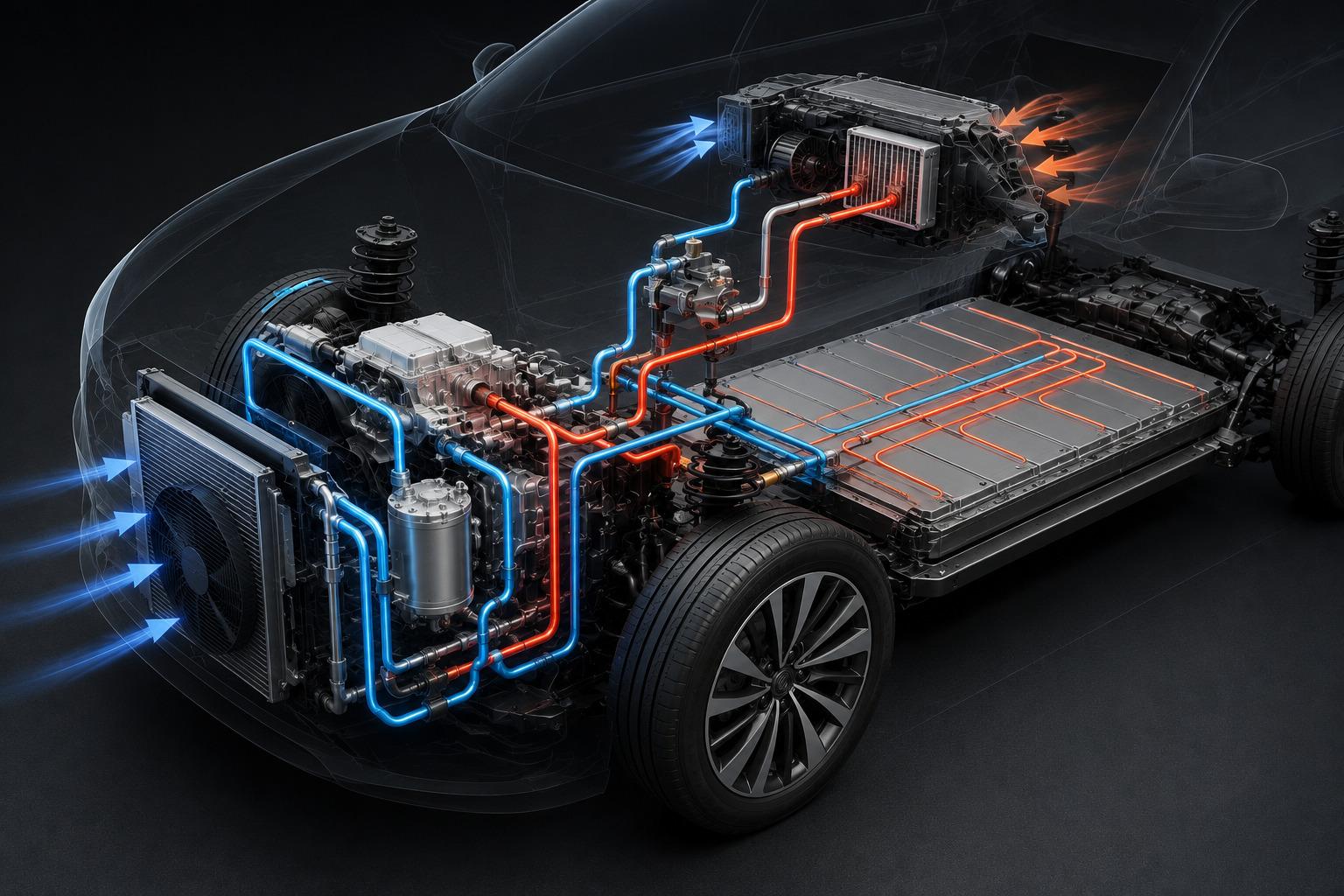
When buying an electric vehicle, most users focus on battery capacity, catalog range, and fast-charging time. However, there is another important factor that affects real-world range, especially in winter: how the vehicle heats its cabin and battery.
The heat pump used in electric vehicles helps reduce the energy consumption required for cabin heating. This way, a larger portion of the energy in the battery can be used for driving.
However, a heat pump does not increase battery capacity and does not provide the same benefit under all conditions. The benefit obtained varies depending on outside air temperature, trip duration, the vehicle's thermal management system, and usage conditions.
For this reason, when choosing an electric vehicle, the question should not only be "Does it have a heat pump?" but also how efficiently the vehicle manages energy under winter conditions.
What Does a Heat Pump Do in Electric Vehicles?
A heat pump is a system that transfers thermal energy present in the outside environment or in vehicle components into the cabin.
In conventional electric heaters, energy drawn from the battery is converted directly into heat. A heat pump, on the other hand, uses electricity to transfer existing heat rather than to generate heat directly.
As a result, under suitable operating conditions, the same cabin temperature can be reached with lower electricity consumption.
How Does a Heat Pump Work?
The operating principle of a heat pump is similar to that of an air-conditioning system.
The system collects heat from the outside air or from vehicle components. The refrigerant is compressed in the compressor, which raises its temperature. This heat is then transferred to the cabin via a heat exchanger.
Even when the outside air is cold, it still contains a certain amount of thermal energy. The heat pump makes use of the portion of this energy that is available for extraction.
What Is the Difference Between a Heat Pump and a PTC Heater?
PTC-type electric heaters and heat pumps are both commonly used for cabin heating in electric vehicles.
A PTC heater converts the electrical energy it draws from the battery directly into heat. It responds quickly and can provide strong heating even at very low temperatures.
A heat pump, on the other hand, transfers existing heat. Because of this, it can offer similar cabin comfort with lower energy use under suitable temperatures.
Feature |
PTC Heater |
Heat Pump |
Operating principle |
Converts electricity directly into heat |
Transfers existing heat |
Energy consumption |
Generally higher |
Lower under suitable conditions |
Performance at very low temperatures |
Strong |
Efficiency and capacity may decrease |
System structure |
Simpler |
More complex |
In many electric vehicles, the heat pump is supported by an auxiliary PTC heater when needed.
Does a Heat Pump Increase Range?
A heat pump does not increase battery capacity and does not add a new energy source to the vehicle.
Its main benefit is that it reduces the energy spent on cabin heating. This way, a larger portion of the energy in the battery can be used for driving.
For this reason, the most accurate statement is as follows:
A heat pump does not directly increase range; it can reduce the range loss caused by climate control in cold weather.
According to an assessment published by the U.S. Department of Energy, in a system examined at an ambient temperature of approximately -6.7°C, the use of a heat pump was able to reduce HVAC power demand by about 38 percent.
However, this result does not mean that the vehicle's range increased by 38 percent. The measurement refers only to the power required for the climate control system under specific test conditions.
Why Does the Range of Electric Vehicles Drop in Winter?
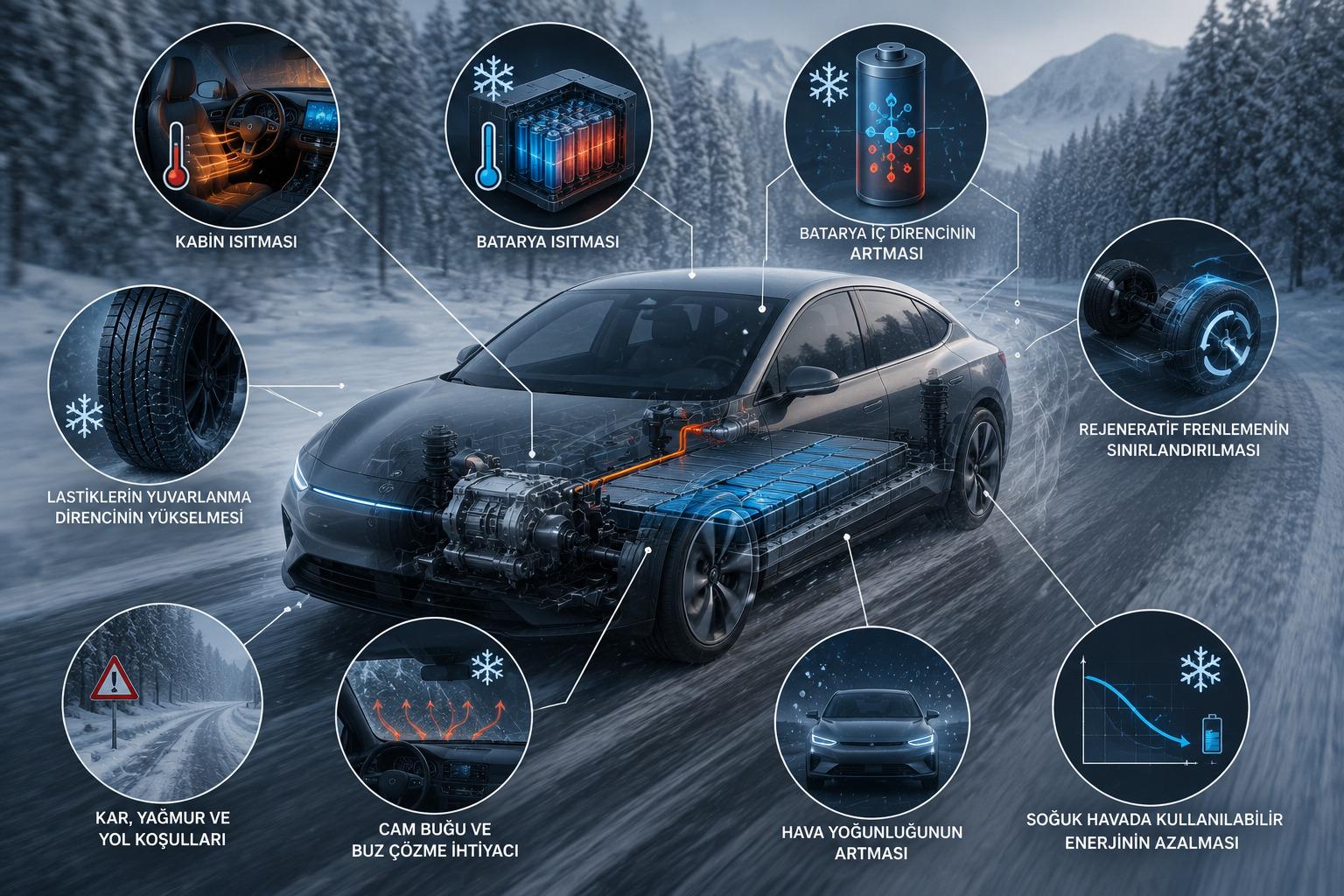
Cabin heating is not the only cause of range loss seen in winter.
Low temperatures also affect the operating conditions of battery cells. Internal resistance of the cells can increase, usable energy can temporarily decrease, and regenerative braking can be limited.
The main factors affecting range in cold weather include:
-
Cabin and battery heating
-
Increased internal resistance of the battery
-
Limited regenerative braking
-
Higher tire rolling resistance
-
Rain, snow, and wet road surfaces
-
Window fogging and the need for defrosting
-
Increased air density
A heat pump does not eliminate all of these effects. It mainly reduces consumption related to cabin heating and, in some vehicles, thermal management.
Does a Heat Pump Also Heat the Battery?
Not in every vehicle. In some electric vehicles, the heat pump is used only for cabin climate control. In more advanced systems, the cabin, battery, electric motor, and power electronics can be managed together within a shared thermal architecture.
For battery heating, manufacturers may use different solutions such as a heat pump, a PTC liquid heater, an in-battery electric heater, or waste heat from the motor and inverter.
Therefore, the presence of a heat pump in a vehicle does not necessarily mean that the battery is heated by the heat pump.
Are a Heat Pump and Battery Preconditioning the Same Thing?
Battery preconditioning is the process of bringing the battery to a suitable temperature before driving or fast charging.
When the battery is too cold, DC fast-charging power can drop, charging time can lengthen, and regenerative braking can be temporarily limited.
Some electric vehicles automatically start battery heating when a fast-charging station is selected in navigation.
A heat pump is a thermal energy transfer system. Battery preconditioning, on the other hand, is a vehicle function that brings the battery to a suitable temperature.
A vehicle may have a heat pump but still have limited battery preconditioning. Likewise, a vehicle without a heat pump can perform preconditioning using a separate electric heater.
What Does Preheating the Vehicle While Charging Provide?
If cabin preconditioning is performed while the vehicle is plugged in to charge, the energy required for heating can be drawn from the electrical grid.
This way, when driving begins, the battery does not have to spend a large amount of energy heating the cold cabin for the first time.
This practice:
-
Can reduce consumption during the first minutes of driving.
-
Increases cabin comfort.
-
Makes it easier to clear ice and fog from the windows.
-
Helps preserve winter range.
Preconditioning is particularly beneficial for short urban trips.
What Is Integrated Thermal Management?
In modern electric vehicles, thermal management does not mean only heating or cooling the cabin.
The battery, electric motor, inverter, onboard charger, and passenger cabin all have different temperature requirements.
An integrated thermal management system manages the heat flow between these components together. For example, waste heat generated in the motor or power electronics can be used for cabin heating. The battery can be heated before fast charging, or excess heat generated during charging can be removed.
The efficiency of these systems does not depend on hardware alone. Thermal management software controls the compressor, pumps, fans, and valves based on outside temperature, battery temperature, cabin demand, and driving conditions.
For this reason, two electric vehicles with similar hardware can show different winter consumption due to differences in software and calibration.
Does a Heat Pump Work in Very Cold Weather?
Yes, it can work. However, as outside air temperature drops, the system's efficiency and heating capacity can decrease.
In very cold weather, the compressor may run more, energy consumption may increase, and the auxiliary PTC heater may kick in.
If frost forms on the outdoor heat exchanger in cold, humid weather, the system may switch to a defrost cycle. During this time, cabin heating capacity can temporarily decrease and energy consumption can temporarily increase.
For this reason, simply knowing that "the vehicle has a heat pump" is not enough. How the system performs at low temperatures also matters.
What Are the Advantages and Limitations of a Heat Pump?
The main advantages of a heat pump are:
-
It can reduce the energy consumption of cabin heating.
-
It contributes to better preservation of winter range.
-
It can make use of waste heat from vehicle components.
-
In integrated systems, it can support battery thermal management.
On the other hand, it has some limitations:
-
Its efficiency can decrease at very low temperatures.
-
It has a more complex structure compared to a PTC heater.
-
Production and repair costs can be higher.
-
In some vehicles, it is offered as a paid option.
For Whom Is a Heat Pump More Important?
A heat pump is especially meaningful for the following users:
-
Those living in cold climates
-
Those who frequently take long trips in winter
-
Those who park their vehicle outdoors
-
Those using a vehicle with limited battery capacity
-
Those who consider winter range important in their purchase decision
For users living in a mild climate, driving short daily distances, and regularly charging their vehicle at home, a heat pump may be less critical.
How to Check Whether an Electric Vehicle Has a Heat Pump When Buying
Whether a vehicle has a heat pump should not be confirmed solely from sales listings or user reviews.
Equipment on the same model can vary depending on model year, production date, battery option, country, and equipment package.
The most reliable sources are:
-
The manufacturer's current technical specification page
-
The official price and equipment list
-
The vehicle configurator
-
The owner's manual
-
Equipment information linked to the chassis number
-
Authorized dealer or service records
For this reason, attention should be paid not only to the model name but also to the relevant model year and equipment package.
Do the Togg T10X and T10F Have a Heat Pump?
In Togg's official product catalogs — the T10F dated September 2025 and the T10X dated October 2025 — a heat pump is not listed as standard equipment, an option, or a package feature.
Both models feature dual-zone automatic climate control, and some trim levels offer winter comfort features such as a heated windshield, heated seats, and a heated steering wheel.
However, these features do not serve the same function as a heat pump.
This assessment is based on the Turkey product catalogs published on the dates indicated. Since the manufacturer may make changes in later model years or equipment packages, current official documents should be checked again before purchase.
Is a Heat Pump Essential When Buying an Electric Vehicle?
No. A heat pump is a useful feature, but it is not mandatory for every user.
If you live in a cold region, drive long distances in winter, or place high importance on winter range, it may be more valuable to you.
In addition to the heat pump, the following features should also be considered in a purchase decision:
-
Net usable battery capacity
-
Real winter range
-
Battery and cabin preconditioning
-
DC fast-charging curve
-
Vehicle weight and aerodynamics
-
Thermal management software
-
Service infrastructure
A vehicle that has a heat pump but insufficient battery preconditioning may not deliver the expected fast-charging performance in winter.
For this reason, attention should be paid not to a single piece of equipment but to the vehicle's overall energy and thermal management system.
Frequently Asked Questions
What does it mean for an electric vehicle to have a heat pump?
It is a vehicle that does not rely solely on electric resistance heating for the cabin, but also makes use of heat obtained from the outside environment or from vehicle components.
What does a heat pump do in electric vehicles?
It helps reduce the energy consumption of cabin heating and helps limit range loss in cold weather.
Does a heat pump increase range?
It does not increase battery capacity. It can reduce the range loss caused by climate control in cold weather.
Does a heat pump heat the battery?
It depends on the vehicle's architecture. In some vehicles it contributes to battery thermal management, while in others a separate heating system is used.
Can you buy an electric vehicle without a heat pump?
Yes. A heat pump is an important advantage, but it is not the only purchasing criterion.
Do the Togg T10X and T10F have a heat pump?
In Togg's official product catalogs — the T10F dated September 2025 and the T10X dated October 2025 — a heat pump is not listed as standard equipment, an option, or a package feature. Current model year and equipment information should be checked again before purchase.
References
-
U.S. Department of Energy — Impact of Cold Ambient Temperatures and Extreme Conditions on Battery Electric Vehicle Performance
-
National Renewable Energy Laboratory — An Approach for Designing Thermal Management Systems for Electric and Hybrid Vehicle Battery Packs
-
National Renewable Energy Laboratory — Integrated Vehicle Thermal Management for Advanced Vehicle Propulsion Technologies
-
National Renewable Energy Laboratory — Analysis of Off-Board Powered Thermal Preconditioning in Electric Drive Vehicles
-
National Renewable Energy Laboratory — Climate Control Load Reduction Strategies for Electric Drive Vehicles
-
National Renewable Energy Laboratory — Comparison of Thermal Management Approaches for Integrated Traction Drives
-
SAE International — Design and Research on the Thermal Management Integrated Control System of BEV Based on Heat Pump Air Conditioner
-
SAE International — Cabin Heating Modelling and Simulation for ICE and Electric Vehicles
-
Energy Conversion and Management — Effects of Ambient Temperature on Electric Vehicle Range and Energy Consumption
-
Togg — T10X Official Product Page
-
Togg — T10F Official Product Page
-
Togg — How Do Electric Cars Work?