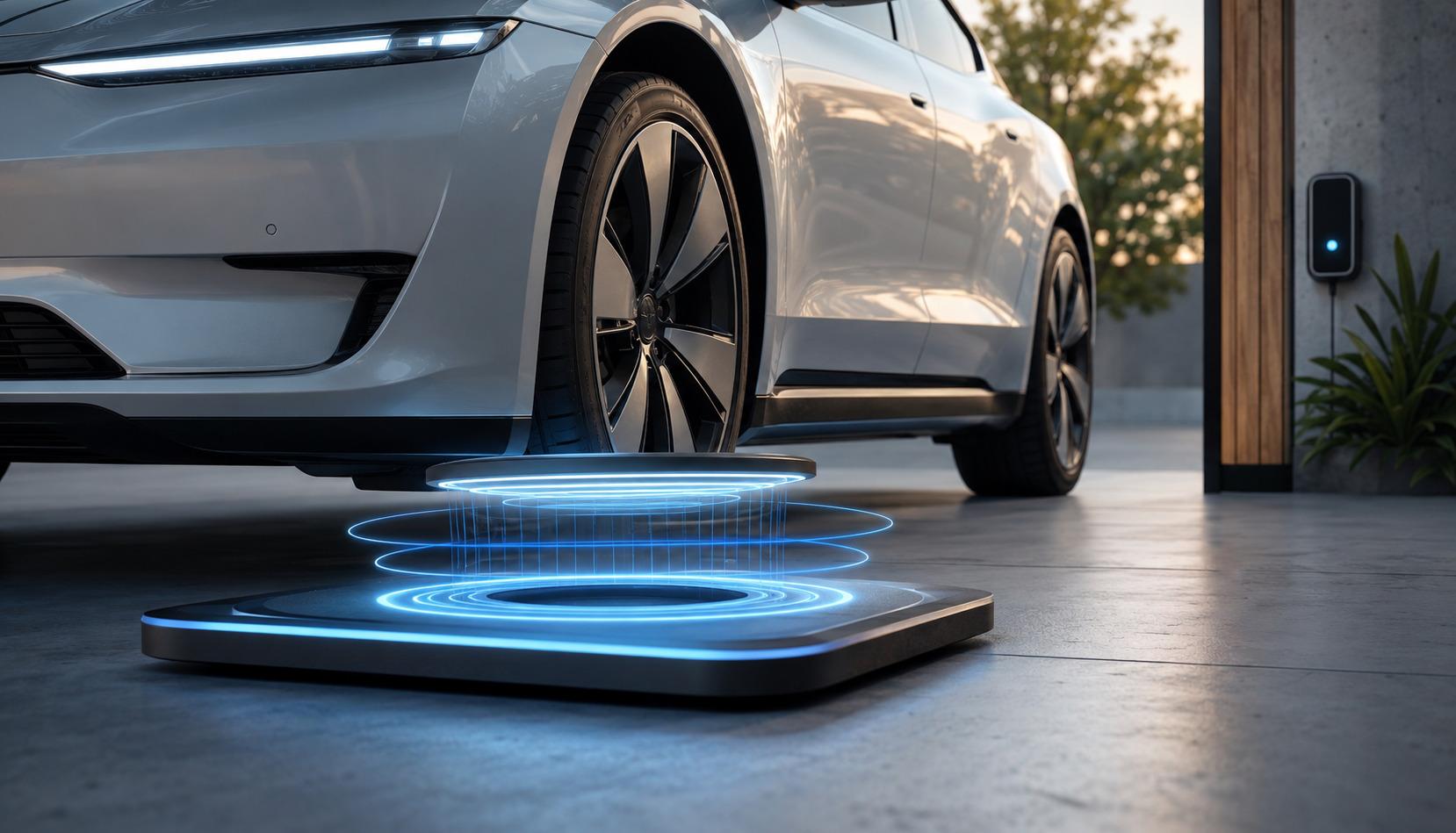
Charging an electric vehicle doesn't always require plugging in a cable. Wireless charging technology allows electrical energy to be transferred to a vehicle's battery without a physical connection.
The driver parks the vehicle in the appropriate charging area. Energy transfer then begins between the transmitter unit on the ground and the receiver unit under the vehicle. This way, the battery can be charged without removing a cable from the vehicle or plugging it into a charging socket.
Today the technology is being evaluated especially for homes, parking lots, taxi stands, and fleet centers. Systems that can transfer energy while the vehicle is moving are still mostly used in pilot projects and research studies.
What Is Wireless Charging in Electric Vehicles?
Wireless charging in electric vehicles is the transfer of electrical energy to the vehicle through a magnetic field.
The system has two basic parts:
-
A transmitter unit placed on the ground
-
A receiver unit placed under the vehicle
The ground unit creates a magnetic field. The receiver system under the vehicle converts this energy into electrical energy. The vehicle's power electronics and Battery Management System then regulate the energy according to the battery's needs.
The working principle is similar to wireless charging on mobile phones. However, electric vehicles require much higher power, advanced cooling, and comprehensive safety systems.
In international documents, this technology is generally referred to as Wireless Power Transfer (WPT).
How Does Wireless Charging Work in a Car?
The wireless charging process basically takes place in five stages.
1. The vehicle is parked in the charging area
The vehicle is parked over or near the ground charging unit. A camera, sensor, or the vehicle's display can help the driver get into the correct position.
Correct alignment is important. If the vehicle is in the wrong position, the system may not start charging, or losses in energy transfer may increase.
2. The ground unit creates a magnetic field
Energy drawn from the electrical grid is regulated by the charging system's power electronics. A variable magnetic field is then created in the transmitter coil on the ground.
3. The vehicle receives the energy
The receiver coil under the vehicle collects energy from the resulting magnetic field. During this process, no physical electrical connection is made between the ground and the vehicle.
4. The energy is made suitable for the battery
The received energy is not sent directly to the battery. Electronic systems in the vehicle regulate the voltage and current. The Battery Management System also monitors temperature, charge level, and permitted power values.
5. Safety is continuously monitored
The vehicle and the charging unit communicate throughout the process. The system continuously checks:
-
Whether the vehicle is in the correct position
-
Temperature values
-
The power being transferred
-
Electrical faults
-
Foreign objects in the charging area
For example, if a metal object is detected in the charging area, energy transfer may not start or may be automatically stopped.
How Efficient Is Wireless Charging?
The efficiency of wireless charging is not a single fixed value.
The main factors affecting performance are:
-
The position of the vehicle relative to the charging unit
-
The distance between the ground and the vehicle
-
Charging power
-
Coil design
-
The quality of the electronic systems
-
Operating temperature
Energy losses can be reduced when the coils are correctly aligned. When alignment is off, efficiency can drop and the system can heat up more.
Oak Ridge National Laboratory announced in a research study that it wirelessly transferred 100 kW of power to an electric vehicle with about 96 percent efficiency. The laboratory later also demonstrated an experimental system at the 270 kW level. However, since these results were obtained under research conditions, they should not be taken to mean that every product on the market offers the same performance.
When evaluating a wireless charging product, one should look not only at the highest power value, but also at real-world usage efficiency, vehicle compatibility, and alignment tolerance.
Is Wireless Charging Safe?
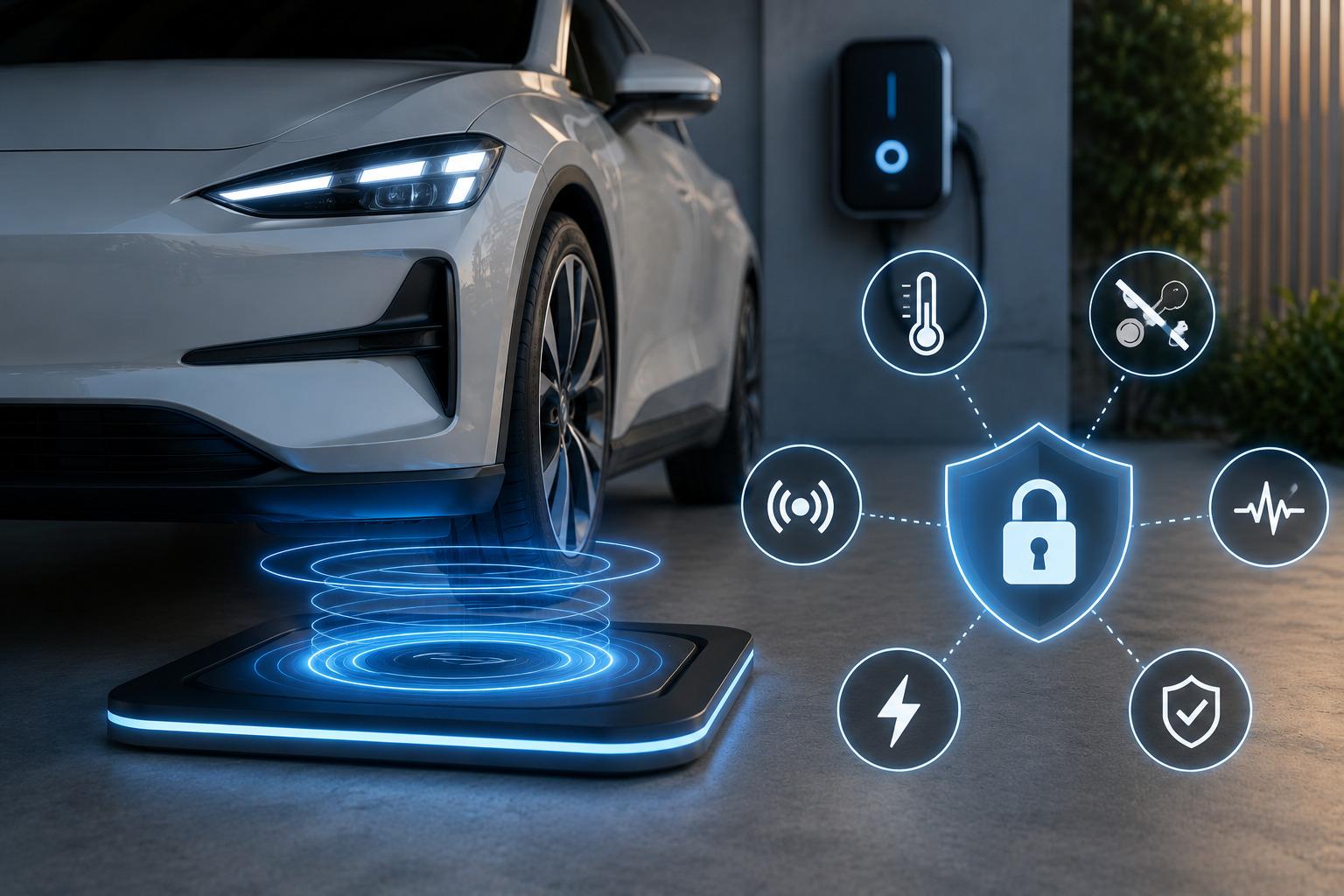
Wireless charging systems developed in line with standards use various protection mechanisms to carry out energy transfer safely.
These include:
-
Over-temperature protection
-
Leakage current control
-
Misalignment detection
-
Foreign metal object detection
-
Electromagnetic field control
-
Automatic power cutoff in case of a fault
A coin or another metal object entering the wireless charging area can cause that object to heat up. For this reason, advanced systems check the charging area before energy transfer begins.
People with a pacemaker or another active medical device should take into account the specific safety disclosures issued by the vehicle and charging equipment manufacturer.
What Are the Advantages of Wireless Charging?
-
Reduces the need to use a cable. The driver doesn't need to plug a charging cable into the vehicle and put it away afterward.
-
Can automate the charging process. When the vehicle is parked in the correct position, authentication and charging can start automatically.
-
Can improve accessibility. It can offer an easier experience for users who have difficulty lifting a cable or plugging a connector into the vehicle.
-
Can simplify fleet operations. Taxis, shuttle, bus, and logistics vehicles can be charged automatically while parked or waiting.
-
Important for autonomous vehicles. A driverless vehicle cannot plug in a cable on its own. Wireless charging is one of the solutions that can allow autonomous vehicles to receive energy without human intervention.
What Are the Limitations of Wireless Charging?
-
Installation cost can be higher. A transmitter unit must be installed in the ground, and a receiver coil plus additional electronic hardware must be installed in the vehicle.
-
Not compatible with every vehicle. A wireless charging pad alone cannot charge a standard electric vehicle. The vehicle must have compatible receiver hardware and software support.
-
Correct parking is important. If the vehicle is not properly aligned with the charging area, energy transfer may not start, or efficiency may drop.
-
Adds extra hardware to the vehicle. The receiver coil, protective housing, and electronic components can increase the vehicle's weight and manufacturing cost.
-
Infrastructure installation is more complex. For in-ground installations, electrical connection, drainage, mechanical durability, communication, and maintenance access must all be planned together.
Differences Between Wired and Wireless Charging
Criterion |
Wired charging |
Wireless charging |
Energy transfer |
Via cable and connector |
Via magnetic field |
User action |
Cable must be plugged in |
Can start automatically |
Vehicle compatibility |
More widespread |
Requires special hardware |
Alignment |
Not important |
Correct parking matters |
Infrastructure |
More mature and widespread |
Still more limited |
Cost |
Generally lower |
Can be higher |
Automation |
May require an extra mechanism |
Well suited to automation |
The strongest point of wireless charging is ease of use. Wired charging, on the other hand, is currently more widespread, more economical, and compatible with more vehicles.
For this reason, wireless charging is expected to become a solution that complements wired charging in the near future, rather than replacing it entirely.
Does Wireless Charging Work in Rain and Snow?
Wireless charging systems developed for outdoor use can be designed to withstand rain, snow, dust, and temperature changes.
An important advantage is that there are no exposed electrical contacts touched by the user during energy transfer. However, this does not mean that every product can be used in all weather conditions.
Before installation, the following product features should be checked:
-
Water and dust protection rating
-
Operating temperature
-
Corrosion resistance
-
Icing conditions
-
Mechanical load capacity
The manufacturer's installation and usage instructions must always be followed.
Does Wireless Charging Damage the Battery?
In wireless charging, energy is not sent to the battery in an uncontrolled way.
The Battery Management System continuously monitors:
-
Battery temperature
-
Cell voltages
-
Charge level
-
The permitted charging power
The main factor that determines battery health is not whether the energy is delivered by cable or wirelessly. Temperature, charging power, the battery's state of charge, and the vehicle's charge management are far more decisive.
A system approved by the vehicle manufacturer and compliant with standards operates in a way that charges the battery within safe limits.
Why Did Siemens Invest in Wireless Charging Technology?
Wireless charging is not just an experimental field of interest to small technology startups. Major technology and automotive companies are also investing in this area.
In June 2022, Siemens invested $25 million in WiTricity, a company that develops magnetic-resonance-based wireless charging systems for electric vehicles, and acquired a minority stake in the company.
According to Siemens' statement, the two companies' goal was to develop wireless charging solutions, support interoperability across different vehicles, and accelerate the global adoption of the technology.
In August 2022, Siemens also launched a partnership with automotive supplier MAHLE on inductive charging systems for electric vehicles. This work aimed to ensure that the receiver equipment on the vehicle and the charging infrastructure on the ground work compatibly across different manufacturers, and to address gaps in the standards.
These investments show that wireless charging is seen not merely as a comfort feature, but as a strategic technology for the future of automated and autonomous mobility.
The Future of Wireless Charging
It is more likely that wireless charging will first become widespread in specific operations rather than in every use case.
Areas that could stand out include:
-
Home and residential parking lots
-
Taxi fleets
-
Public transit vehicles
-
Logistics centers
-
Robotic parking systems
-
Autonomous vehicles
-
Elderly users or users with limited mobility
For the technology to be used on a wider scale, costs need to come down, vehicle manufacturers need to support the system, and infrastructure needs to work compatibly across vehicles from different brands.
Dynamic wireless charging is a longer-term option. Changes to road infrastructure, energy metering, billing, and maintenance costs will determine the future of this technology.
Frequently Asked Questions
Can every electric vehicle be charged wirelessly?
No. The vehicle must have a compatible receiver coil, power electronics, and software support.
Is no cable used at all for wireless charging?
No charging cable is used between the vehicle and the charging unit. However, the ground system is connected to the electrical grid by cable.
Is wireless charging slower than wired charging?
Not always. Charging time depends on the power of the system and the energy level the vehicle can accept.
What happens if the vehicle is parked incorrectly?
The system may not start charging, or it may operate at lower efficiency.
Does wireless charging damage the battery?
In a system approved by the manufacturer, the charging process is controlled by the Battery Management System. Temperature and charge management are the main factors determining battery health.
Can wireless charging be used in the rain?
Systems designed for outdoor use with an appropriate protection rating can be used in the rain. The product's technical specifications and the manufacturer's instructions should be checked.
References
-
International Energy Agency – Global EV Outlook
-
IEC 61980-1 – Electric Vehicle Wireless Power Transfer Systems
-
IEC 61980-2 – Communication and Positioning Requirements
-
IEC 61980-3 – Magnetic Field Wireless Power Transfer Systems
-
ISO 19363 – Magnetic Field Wireless Power Transfer
-
SAE International – SAE J2954 Wireless Power Transfer
-
Oak Ridge National Laboratory – 100 kW Wireless Charging Demonstration
-
Oak Ridge National Laboratory – 270 kW Wireless Charging Demonstration
-
Siemens – Siemens Invests in WiTricity
-
Siemens – Siemens and MAHLE Wireless Charging Cooperation