The electric vehicle market in Turkey is no longer merely a prospect for the future; it has become a powerful driver of transformation directly impacting today’s transportation, energy, and consumer experiences. As the number of electric vehicles rises rapidly, the charging infrastructure is being reshaped in terms of both geographic coverage and fast-charging capabilities.
The "Electric Vehicle and Charging Infrastructure Projection" by the EPDK (Energy Market Regulatory Authority) outlines the current state of electric vehicle adoption in Turkey, how the charging network is responding to this growth, and the projected development for the years 2030, 2035, and 2040.
The projection integrates a wide range of factors: the electric vehicle fleet, automotive market growth, population dynamics, provincial vehicle ownership rates, current charging point density, urban and intercity charging needs, the impact of tourism, major transportation corridors, AC/DC distribution, and future forecasts provided by electric vehicle manufacturers. Consequently, the projection offers a more realistic perspective for prospective buyers asking, "What will the infrastructure situation look like if I purchase an electric vehicle?"
The Electric Vehicle Market is Growing Faster than Expected
The number of electric vehicles in Turkey has seen rapid growth in recent years. While there were only 1,465 electric vehicles on the road in 2019, that figure reached 373,733 by the end of 2025. As of the end of March 2026, the total number of electric vehicles in Turkey stands at 411,796. This total encompasses automobiles, minibuses, light trucks, trucks, tractors, and buses.
The most notable aspect of this growth is that electric vehicles are shifting from being the choice of a niche user group to becoming a significant part of the mainstream automotive market. In particular, the figures recorded in 2025 indicate that demand for electric vehicles in Turkey grew faster than had been projected in 2024.
As of the end of March 2026, the vast majority of electric vehicles fall into the automobile category:
Vehicle Type |
Number of electric vehicles as of the end of March 2026 |
|---|---|
Automobile |
408.314 |
Van |
2.787 |
Minibus |
346 |
Bus |
304 |
Truck |
29 |
Tractor |
16 |
Total |
411.796 |
Looking at this picture, the electric vehicle market in Turkey is currently growing primarily through passenger cars, whereas growth potential in the commercial vehicle, light truck, and bus segments is still in the early stages.
Charging Infrastructure is Also Growing: Türkiye has 41,938 Commercial Charging Points
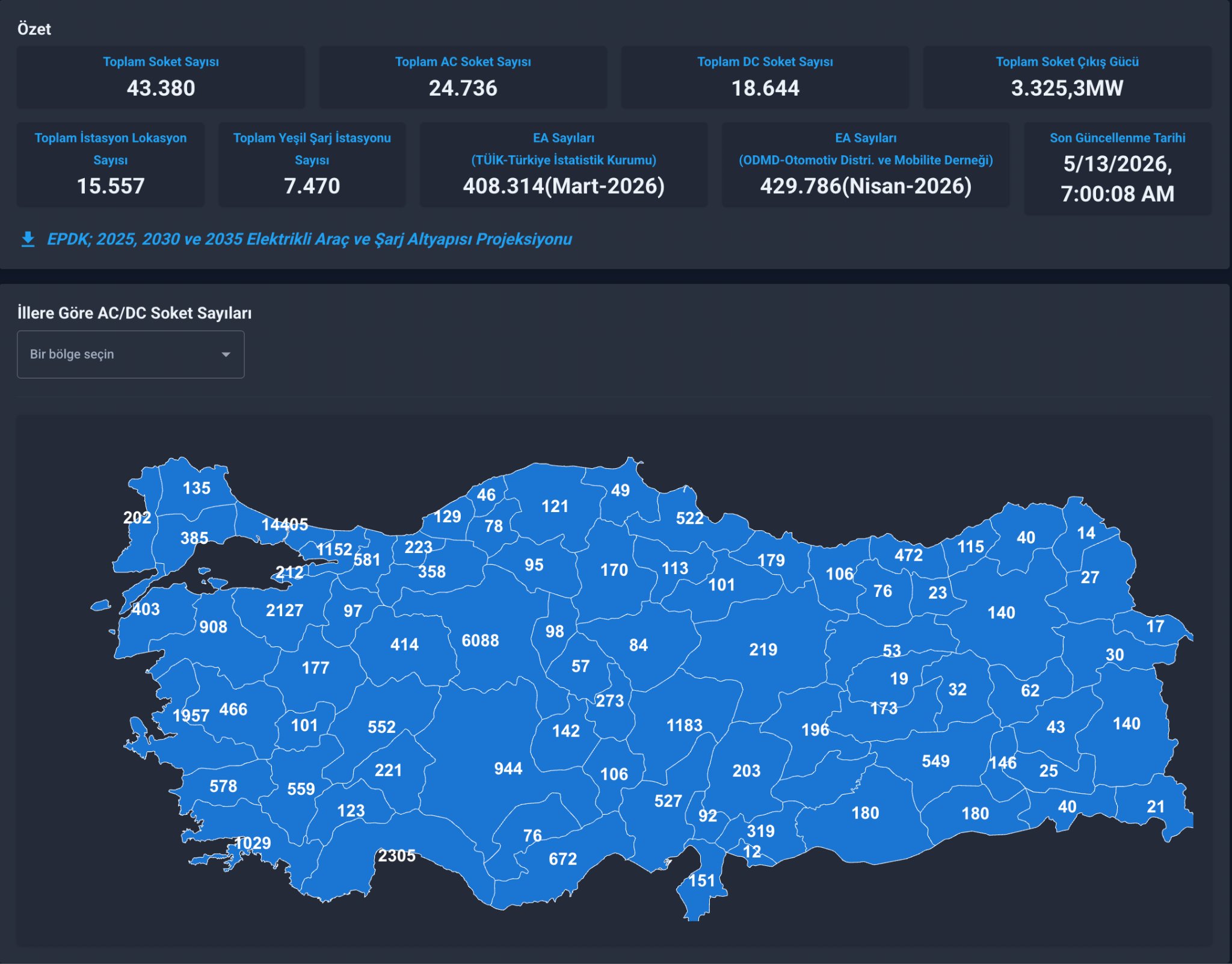
EVCify Data Sharing Platform: Charging network points as of May 2026
One of the key questions for users considering the purchase of an electric vehicle is:
“Where and how easily can I charge my vehicle?”
According to the EPDK projection for April 2026, the total number of commercial charging points in Turkey reached 41,938 by the end of March 2026. Of these, 23,900 are AC charging points and 18,038 are DC charging points.
Charging Point Type |
Amount as of the end of March 2026 |
Approximate Share |
|---|---|---|
AC Charging Point |
23.900 |
%57 |
DC Fast Charging Point |
18.038 |
%43 |
Total |
41.938 |
%100 |
The critical point here is not merely the total number of charging points. The truly noteworthy development is the high share of DC (fast) charging points within the total. In Turkey, approximately 43% of commercial charging points are DC fast chargers. This ratio is highly significant for users who travel between cities, require quick charging, or have limited home charging options.
In other words, Turkey’s charging infrastructure is evolving not simply through a "more sockets" approach, but through the deployment of faster, more powerful, and strategically located charging points.
How Many Electric Vehicles Are There Per Charging Point?
One of the most practical metrics for electric vehicle users is the number of electric vehicles per charging point. As of the end of March 2026, it is reported that there are 9.8 electric vehicles for every charging point in Turkey. Additionally, the public charging capacity available per electric vehicle is calculated at 7.75 kW. Projections indicate that these figures represent a favorable standing compared to the global average.
For the end user, this data conveys the following:
Although the number of electric vehicles in Turkey is rising rapidly, the public charging infrastructure is expanding in tandem with this growth. In particular, the significant share of DC fast-charging points makes using electric vehicles for long-distance travel more feasible.
However, there is an important distinction to be made here. While the expansion of charging infrastructure across Turkey is positive, the user experience can vary from city to city—and even from location to location within the same city. Therefore, prospective electric vehicle buyers should look beyond the total number of charging points nationwide and consider the charging facilities available in their local area, along their frequent travel routes, and near their workplace.
How Much Electricity Was Consumed at Charging Stations in 2025?
One of the strongest indicators of the electric vehicle ecosystem's growth is the electricity consumption within the charging service market.
In 2025, total electricity consumption for charging services amounted to 458,516 MWh. Of this, 288,629 MWh was supplied by green charging stations. Green charging stations accounted for 62.95% of the total consumption.2025 Charging Service Data |
Value |
|---|---|
Total electricity consumption |
458.516 MWh |
Consumption from green charging stations |
288.629 MWh |
Share of green charging in total consumption |
%62,95 |
Total charging duration |
20.443.075 saat |
Total number of charging sessions |
21.701.880 |
Average consumption per charging session |
21,13 kWh |
Average duration per session |
0,94 saat |
An average consumption of 21.13 kWh per charging session suggests that a single charge covers a significant portion of daily driving needs for many EV owners, while the average session length of 0.94 hours points to an increasingly manageable charging experience. Overall, this data indicates that EV adoption in Turkey can now be tracked not just through vehicle sales, but through actual charging behavior across the market.
What Did the April 2024 Projection Forecast?
In its projection approved in April 2024, EPDK (Turkey's Energy Market Regulatory Authority) had developed low, medium, and high scenarios for the number of electric vehicles in Turkey for 2025, 2030, and 2035.
Under the medium scenario in the 2024 projection, the expected number of electric vehicles was as follows:Year |
2024 Projection – Medium Scenario EV Count |
|---|---|
2025 |
269.154 |
2030 |
1.321.932 |
2035 |
3.307.577 |
Under the same projection, the high scenario for 2025 stood at 361,893 electric vehicles.
However, actual results exceeded these expectations. The number of electric vehicles in Turkey reached 373,733 by the end of 2025 — surpassing not only the medium scenario from the 2024 projection, but also the high scenario set for 2025.
This marks a highly significant turning point for Turkey's electric vehicle market, as the market outperformed even the high-growth expectations set just two years earlier.
Why Does the 2026 Update Present Higher EV Expectations?
In the updated 2026 projection, electric vehicle forecasts were revised upward. This is primarily attributed to the EV market in Turkey growing faster than expected in the recent period, along with shifting market dynamics.
The projection study did not rely solely on past sales trends. Factors such as the pace of transition to electric vehicles, total vehicle stock, the young population, growth in the automotive market, potential EV incentives, declining consumer concerns, and the speed at which automakers are shifting to electric technology were all taken into account. Forecasts from EV manufacturers and importers regarding future years were also incorporated into the study.
As a result of this approach, new forecasts were established in the 2026 projection for the years 2030, 2035, and 2040:
Year |
Low Scenario |
Medium Scenario |
High Scenario |
|---|---|---|---|
2030 |
1.318.043 |
2.295.927 |
2.768.970 |
2035 |
2.773.899 |
5.629.051 |
7.024.525 |
2040 |
4.976.259 |
10.595.970 |
13.068.521 |
Under the new medium scenario, the number of electric vehicles in Turkey is expected to reach approximately 2.3 million by 2030, 5.6 million by 2035, and 10.6 million by 2040. This outlook indicates that electric vehicles are becoming a permanent and accelerating area of transformation within Turkey's automotive market.
What Has Changed When Comparing the 2024 and 2026 Projections?
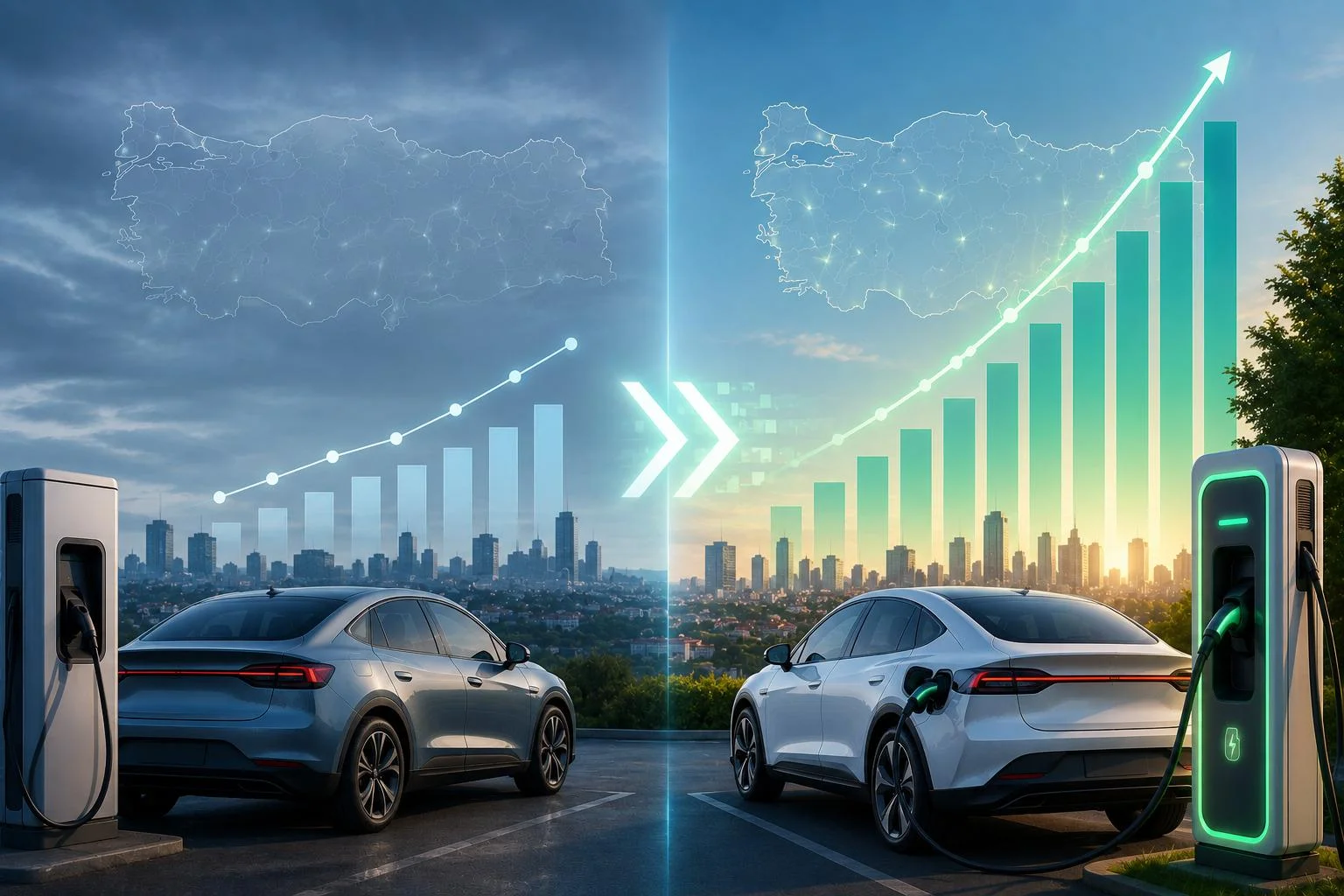
Comparing the 2024 projection with the 2026 update, the clearest shift appears in expectations for the number of electric vehicles.
Year |
2024 Projection – Medium Scenario |
2026 Projection – Medium Scenario |
Approx. Change |
|---|---|---|---|
2030 |
1.321.932 |
2.295.927 |
%74 artış |
2035 |
3.307.577 |
5.629.051 |
%70 artış |
This increase shows that Turkey's EV market has entered a much stronger growth trajectory than what was forecast in 2024.
However, the picture looks somewhat different at first glance when it comes to charging point projections. Under the 2024 projection's medium scenario, total charging points for 2030 were forecast at 142,824; in the 2026 projection, this figure was revised to 127,051. For 2035, the medium-scenario forecast of 273,076 total charging points in the 2024 projection was revised down to 199,174 in the 2026 projection.
Year |
2024 Projection – Total Charging Points, Medium Scenario |
2026 Projection – Total Charging Points, Medium Scenario |
|---|---|---|
2030 |
142.824 |
127.051 |
2035 |
273.076 |
199.174 |
This table should not be interpreted as "charging infrastructure falling behind." Rather, it reflects a more detailed projection methodology — one that focuses not just on the raw number of units, but also on usage intensity, location, the AC/DC balance, and capacity requirements in charging infrastructure planning.
A New Era in Charging Infrastructure: Not Just More Points, but More Powerful Ones in the Right Locations
When calculating the demand for charging points for the 2026 projection, urban and intercity sockets were analyzed separately. To determine the need for urban sockets, factors such as provincial population demographics, vehicle ownership rates, the level of electric vehicle (EV) adoption, and the current ratio of EVs to sockets were taken into account. For intercity requirements, seasonal tourism patterns and key highway transit points within the Trans-European Transport Network were evaluated.
Furthermore, the projection targets an EV-to-socket ratio of 35 by 2035 and 40 by 2040. This approach indicates that the future does not call for the installation of a new public socket for every additional EV; instead, it envisions a transition to a charging network characterized by higher power output, more efficient utilization, and strategic placement in optimal locations.
For the end-user, this development means the following:
In the future, the charging experience will be evaluated not merely by the question "How many sockets are there?" but by asking, "Where are these sockets located, how powerful are they, how accessible are they, and how heavily are they used?"
Strong Growth Expectations Continue on the DC Fast Charging Side
Despite the change in the overall total for charging point projections, the outlook remains stronger on the DC fast charging side.
Year |
2024 DC – Medium Scenario |
2026 DC – Medium Scenario |
Approx. Change |
|---|---|---|---|
2030 |
42.637 |
52.629 |
%23 artış |
2035 |
86.924 |
89.133 |
%3 artış |
By contrast, AC charging point forecasts were revised downward:
Year |
2024 AC – Medium Scenario |
2026 AC – Medium Scenario |
Approx. Change |
|---|---|---|---|
2030 |
100.187 |
74.422 |
%26 düşüş |
2035 |
186.152 |
110.041 |
%41 düşüş |
This shift indicates that Turkey's charging infrastructure is evolving toward a structure increasingly focused on fast charging. DC fast charging is becoming particularly important for intercity travel, highways, main arterial roads, tourism regions, and high-traffic locations.
On the AC charging side, however, a portion of installations made in apartment complexes, residential sites, workplaces, and private areas may not be reflected in public commercial charging statistics. As a result, the projected decline in the number of publicly accessible commercial AC sockets does not necessarily mean that AC charging options for EV users will shrink altogether. Rather, it points to charging behavior becoming more evenly distributed across home, workplace, residential complex, fleet, and public fast-charging locations.
Do Electric Vehicles Put a Strain on the Electrical System?
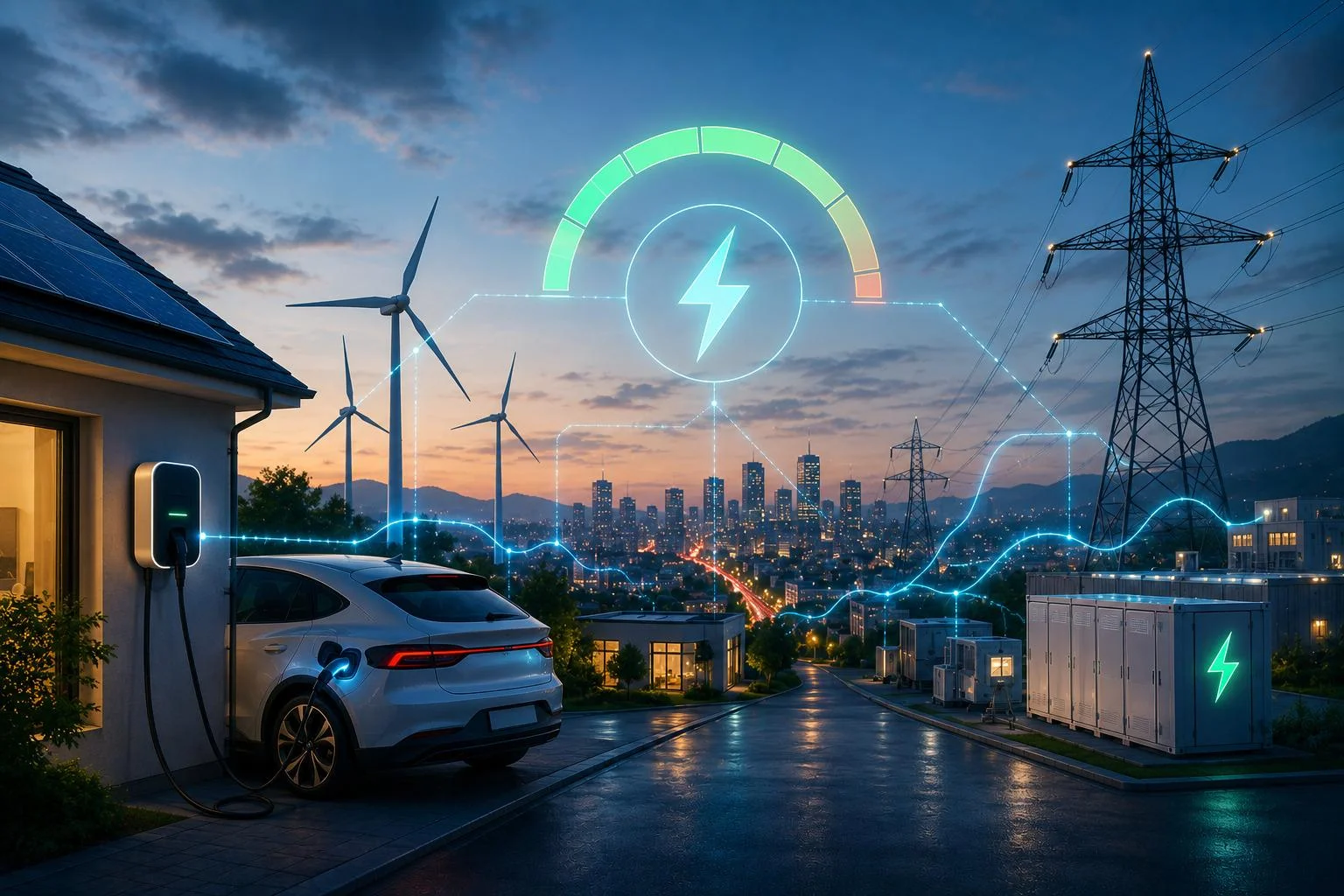
One of the key questions on the minds of prospective electric vehicle buyers is:
“Can the electrical grid handle such a significant increase in electric vehicles?”
According to the EMRA (Energy Market Regulatory Authority) projection from April 2026, total electricity consumption attributable to electric vehicles is forecast to range between 3.84 TWh and 7.71 TWh in 2030, and between 8.23 TWh and 20.67 TWh in 2035. Even under the high-end scenario, it is estimated that the share of electric vehicles in total electricity consumption will remain at approximately 2% in 2030 and around 4% in 2035.
This data indicates that electric vehicles are not expected to pose a significant risk to electricity supply security across Turkey in the short to medium term on their own.
However, there is an important distinction to be made here. While no major risk regarding electricity supply is anticipated at the national level, the same may not always hold true for local distribution grids. A need for additional capacity may arise in specific regions, at certain times of day, and in locations where high-power DC charging points are concentrated. Therefore, the future development of charging infrastructure will be addressed not merely through the installation of new stations, but also through distribution grid planning, power management, smart charging, dynamic load management, and strategic site selection.
What Does This Mean for Users Considering Buying an Electric Vehicle?
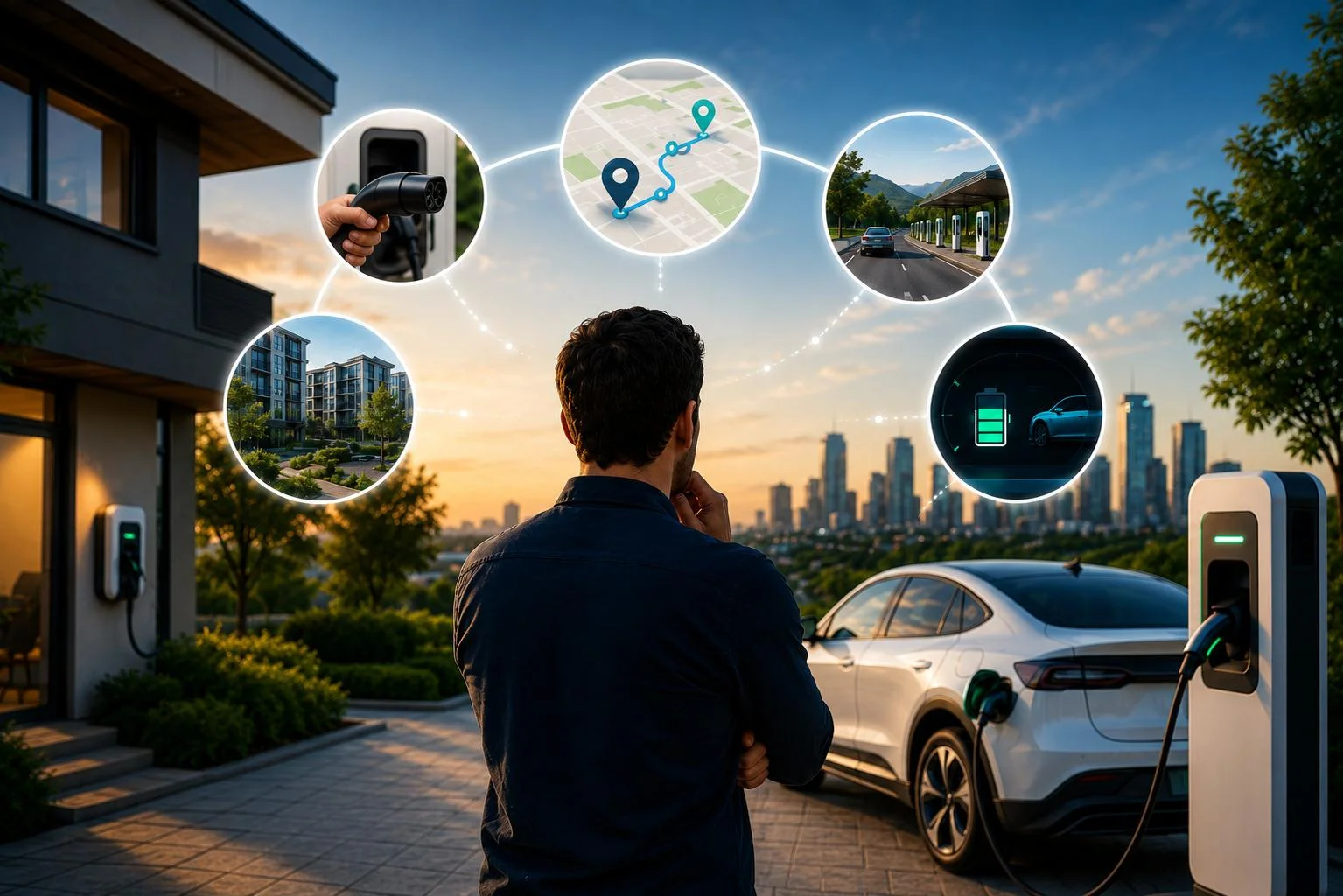
The electric vehicle ecosystem in Turkey has now entered a phase of more mature and visible growth. Actual figures for 2025 have surpassed even the "high" scenario projected for 2024, demonstrating that demand for electric vehicles is stronger than anticipated.
Regarding charging infrastructure, the sector is undergoing a qualitative transformation alongside quantitative growth. The high proportion of DC fast-charging stations serves as a key factor in building confidence, particularly for users undertaking long-distance journeys. However, simply looking at the total number of charging stations nationwide is not sufficient when purchasing an electric vehicle.
A user considering the purchase of an electric vehicle should certainly seek answers to the following questions:User Question |
Why It Matters |
|---|---|
Do I have charging access at home or at work? |
Directly affects daily usage cost and convenience. |
Are there enough AC/DC charging points in the city where I live? |
Determines the daily and weekly usage experience. |
Is DC fast charging available on the intercity routes I frequently use? |
Increases confidence for long-distance trips. |
What is the DC charging acceptance power of the vehicle I plan to buy? |
Directly affects the fast-charging experience. |
Does the battery capacity match my daily needs? |
Helps avoid unnecessary high battery costs. |
Do the charging stations I use get crowded during peak hours? |
Critical for the real-world user experience. |
Therefore, when choosing an electric vehicle, factors such as charging habits, location, travel routine, and vehicle charging technology should be considered alongside range, battery capacity, and price.
An Era of Acceleration Begins in Turkey’s Electric Vehicle Ecosystem
EMRA’s (Energy Market Regulatory Authority) April 2026 projection clearly demonstrates that Turkey’s electric vehicle market is growing faster than originally anticipated in 2024. By the end of 2025, the number of electric vehicles had surpassed the "high scenario" figure from the 2024 projection. As of the end of March 2026, there are 411,796 electric vehicles and 41,938 commercial charging points in Turkey. Of these charging points, 18,038 are DC fast-charging units.
According to the new projection, the number of electric vehicles in Turkey is expected to reach 2.3 million in 2030, 5.6 million in 2035, and 10.6 million in 2040 under the "medium scenario."
This picture indicates that electric vehicles are not merely a passing trend in Turkey, but represent a permanent shift that is simultaneously transforming the automotive and energy sectors, urbanization, and consumer habits.
With each passing year, electric vehicle ownership is becoming a more viable and accessible option in Turkey, supported by increasingly robust infrastructure. However, making the right vehicle choice requires considering more than just range; factors such as charging infrastructure, usage habits, route planning, and the vehicle's charging technology must all be taken into account.
Sources:
-
EVCIFY. “Data Platform.” EVCIFY. Accessed: June 4, 2026.
https://evcify.com/veri-platformu
-
Energy Market Regulatory Authority (EPDK). “Energy Transition: Charging Network Infrastructure Projection.” EPDK. Accessed: June 4, 2026.
https://www.epdk.gov.tr/Detay/Icerik/3-0-234-1040/enerji-donusumusarj-agi-altyapisi-projeksiyonu-
-
Artificial intelligence was used for the visuals.